

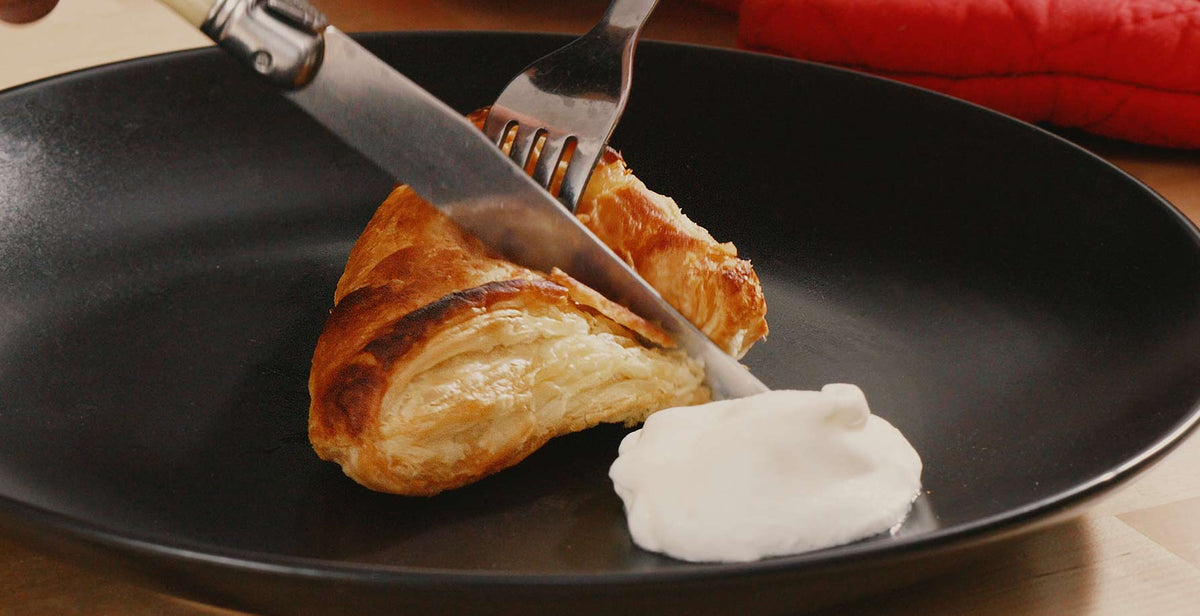
Golden, crispy, irresistibly flaky peach turnovers—just like your favorite neighborhood bakery. Except these cost a fraction of bakery prices, come straight from your freezer, and take only 20 minutes to bake in our HeatMate kitchen.
What if you could enjoy warm, freshly baked pastry without mixing dough, preparing a filling, or waiting for a conventional oven to preheat?
That’s the idea behind our latest HeatMate kitchen experiment.
We started with frozen peach turnovers (from Pepperidge Farm) and explored a two-stage baking technique that uses HeatMate’s rapid graphite heating. The idea was simple. We started with intense heat to help the puff pastry rise, then finished at a lower temperature to develop a golden, crispy exterior.
The result? Beautifully expanded pastry layers, a delicate crunch, and a warm, sweet peach filling.
Add a spoonful of cold Greek yogurt, and you’ve got a delightful breakfast pastry, afternoon treat, or simple dessert—with almost no preparation.
Why You’ll Love This Peach Turnover Recipe
There’s something wonderfully satisfying about making a pastry that looks and tastes elaborate without starting from scratch.
- Bakery-style texture: Crisp, delicate outer layers with a soft peach filling.
- Just 20 minutes of baking: Our HeatMate experiment produced beautifully puffed pastries in 20 minutes.
- Budget-friendly: Frozen turnovers are an inexpensive alternative to buying individual pastries at a bakery.
- Almost no preparation: No mixing, rolling, shaping, or filling required.
- Perfect for two: Prepare a couple of turnovers without heating a full-size oven.
And perhaps the best part? Watching the pastry rise and turn golden through HeatMate’s glass window.
Ingredients

- 2 frozen peach turnovers (Pepperidge Farm)
- 2 tablespoons plain or Greek yogurt, chilled
This recipe for peach turnovers is simple. The frozen pastries already contain prepared puff pastry and sweet peach filling. You don’t need extra butter, sugar, or egg wash.
How to Prepare Puff Pastry Peach Turnovers
Step 1. Start With Frozen Turnovers

Remove two turnovers from the freezer without thawing them.
The pastries were already assembled, eliminating the usual preparation involved in making fruit-filled puff pastry.
Step 2. Prepare the Baking Surface

First, cut a piece of aluminum foil to fit the oven’s cooking area. Then, place the foil beneath the turnovers, leaving the tops exposed.
Step 3. Arrange the Turnovers

Position the frozen pastries approximately 2–3 inches apart.
This spacing leaves room for the dough to expand during baking without the turnovers touching.
Step 4. The Initial High-Heat Stage

This was the most interesting part of our experiment.
Set the HeatMate oven to its maximum temperature of 550°F for the first five minutes and observed how the frozen pastries responded to the intense radiant heat.
The pastry began to lift and expand, creating the layered appearance associated with beautifully baked puff pastry.
Step 5. Reduce the Temperature

After five minutes, reduce the temperature setting to 375–400°F.
Open the glass door (for 2-3 seconds) to release built-up heat before continuing to bake.
Step 6. Continue Baking

Bake the turnovers for another 10 minutes as the pastry continues to expand and gradually develops a golden appearance.
HeatMate’s glass window made it easy to follow the transformation without repeatedly opening the oven.
Step 7. Turn and Finish

Carefully flip the turnovers and bake for another five minutes at the same temperature.
This helped the underside develop additional color and texture.
After 20 minutes, both pastries should look puffed and golden.
Step 8. Serve With Cold Yogurt

Transfer the pastries to serving plates and allow them to cool before tasting.
A generous spoonful of chilled Greek yogurt provides a lovely contrast to the warm peach filling and flaky pastry.
The HeatMate Advantage: Why Does High Heat Make Puff Pastry Rise?
The secret behind beautifully puffed pastry isn’t complicated ingredients. It’s how moisture, fat, and heat work together.
Puff pastry is made from many thin layers of dough separated by fat. As the dough warms, moisture turns into steam, pushing the layers apart and creating the light, airy structure that gives puff pastry its distinctive texture.
This expansion is often called oven spring.
The principle applies whether you’re making homemade pastry or using peach turnovers with puff pastry ready-made.
High temperatures play an essential role in creating beautifully risen puff pastry. As The Kitchn explains in its guide to baking frozen puff pastry, sufficient oven heat generates the steam that separates the pastry's delicate layers. We explored this principle in our HeatMate kitchen experiment, using an initial burst of intense graphite heat to encourage expansion before continuing at a lower temperature.
The Power of Graphite Heating
The HeatMate Graphite Toaster Oven uses advanced graphite heating technology that responds almost instantly when activated.
Its heating element reaches operating temperature in about 0.2 seconds, with a maximum oven temperature of 550°F.
Importantly, this describes the graphite element's rapid heating response, not the temperature of the entire oven chamber.
Its ability to deliver radiant heat almost immediately makes HeatMate particularly interesting for baking experiments where timing and heat-exposure intensity influence pastry expansion and browning.
Two Temperatures, Two Different Jobs
Our experiment separated baking into two distinct stages.
Stage 1 — The Rise: 550°F for 5 Minutes
The initial high-heat exposure was intended to encourage rapid steam formation and separation of the pastry layers.
Stage 2 — The Golden Finish: 375–400°F for 15 Minutes
The lower-temperature stage was intended to add baking time while reducing heat intensity.
The visual results were encouraging. Our peach puff pastry turnovers developed a noticeably raised structure and an attractive golden exterior.
Interestingly, Pepperidge Farm’s published conventional-oven instructions also use a high initial temperature followed by a lower baking temperature: preheating to 475°F and immediately reducing to 400°F when the turnovers enter the oven.
Chef’s Notes
- Starting with frozen turnovers preserves their prepared structure until baking begins.
- Avoid overcrowding the baking surface so the pastries can rise freely.
- A golden exterior provides useful visual cues. Watch the pastry color.
- Handle pastry carefully. Once puffed, the delicate pastry layers can crack or compress if handled roughly.
- Let the peach filling cool. Fruit fillings can retain considerable heat even after the pastry exterior begins cooling.
- Serve with cold yogurt. The slightly tangy flavor and creamy texture balance the sweet peach filling beautifully.
Serving Ideas: A Bakery Experience at Home
One of the pleasures of a warm peach turnover is that it needs very little decoration.
Our favorite presentation is wonderfully simple: one golden pastry on a plate, accompanied by a spoonful of thick, unsweetened Greek yogurt.
For additional flavor, add a pinch of cinnamon or a few slices of ripe peach.
For dessert, replace the yogurt with a small scoop of vanilla ice cream.
Or serve these delightful peach pockets with a freshly brewed espresso or cappuccino for a café-style afternoon break.
The combination of crisp pastry, warm fruit, and something cool and creamy makes even a simple frozen turnover feel special.
Frequently Asked Questions
What are peach turnovers?
Peach turnovers are individual pastries made by folding dough around a sweet peach filling. They’re commonly triangular.
Can you make peach turnovers with puff pastry sheets?
Absolutely. Puff pastry sheets work beautifully for homemade turnovers.
Do frozen peach turnovers need to thaw before baking?
No. Pepperidge Farm’s conventional-oven instructions say to bake the turnovers directly from frozen.
Why does puff pastry rise during baking?
As the moisture inside the dough heats, it creates steam that separates the thin layers. This produces the characteristic airy, flaky structure.
How long do peach turnovers take to bake?
Our HeatMate experiment lasted 20 minutes.
Are peach pockets the same as peach turnovers?
The terms are sometimes used interchangeably. Turnovers generally refer to folded pastries, while peach pockets may describe various shapes of enclosed peach-filled pastries.
A Little Bakery Luxury at Home
A golden, flaky pastry doesn’t have to be an expensive bakery purchase or an elaborate weekend baking project.
Our HeatMate experiment started with an inexpensive box of frozen turnovers and a simple question: could the rapid graphite heating system encourage the beautiful pastry expansion we associate with a neighborhood bakery?
Twenty minutes later, the results were promising.
Delicate golden layers, sweet peach filling, and a spoonful of cold yogurt made an impressive treat with minimal prep.
And perhaps the most exciting discovery was watching the pastry transform behind HeatMate’s glass window.
It’s a reminder that great cooking isn’t always about complicated recipes. Sometimes, it’s about understanding what heat can do.
Discover the HeatMate Graphite Toaster Ovens and explore the possibilities of rapid, responsive heating. For other puff pastry recipes, check our toaster oven recipes section.
Share:
Baked Salmon with Roasted Fennel & Vegetables