

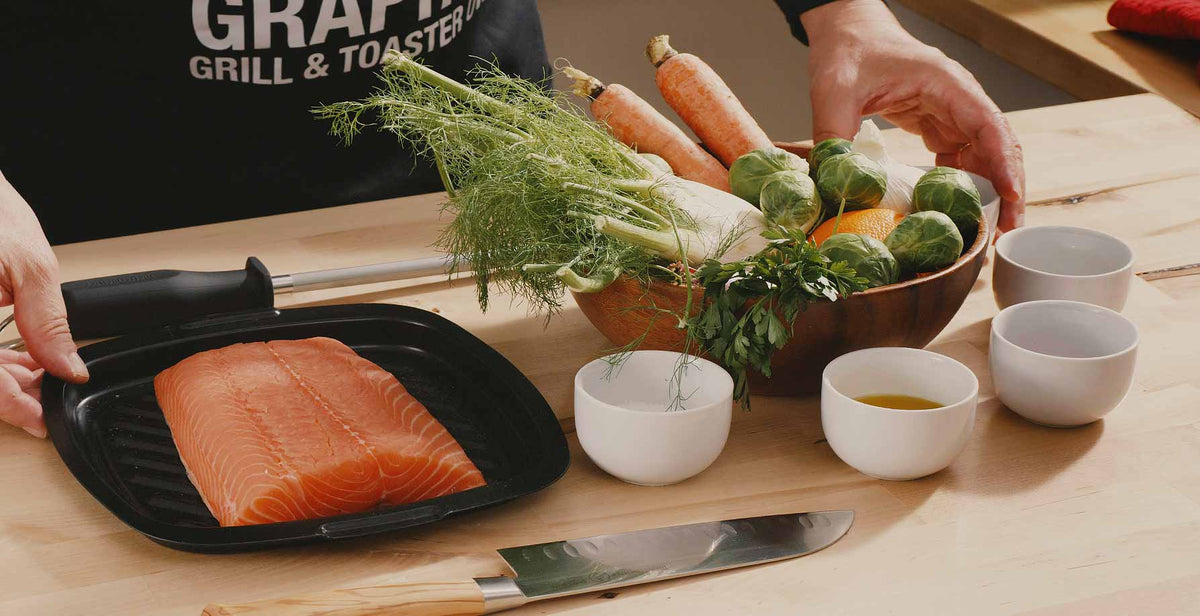
This baked salmon recipe pairs salmon with roasted fennel, carrots, Brussels sprouts, shallot, and garlic. Then, it finishes with a bright orange-honey dressing. The vegetables get a high-heat head start before the salmon joins them, so everything finishes together without sacrificing the fish's texture.
Serves: 1 generous portion
Prep time: about 25–30 minutes, including the short salmon dry brine
Cook time: about 14–17 minutes
Oven: HeatMate toaster oven
Why This Recipe Works
The challenge with cooking salmon and vegetables together is timing.
Carrots, Brussels sprouts, fennel, and shallot need substantially more time than a 4–5 oz salmon portion. If you put everything in the oven at the same time, you're usually forced to choose between undercooked vegetables and overcooked fish.
This oven-baked salmon solves that problem with a simple two-stage method.
First, roast the vegetables covered over high heat so they tenderize quickly. Then uncover them briefly to start browning. Then the HeatMate toaster oven drops to 400°F, and the salmon joins the vegetables for the final few minutes.
This streamlined salmon bake uses different temperatures for different ingredients.
Why Fennel Works So Well with Salmon and Orange
Carrots and Brussels sprouts are familiar companions for salmon. Fennel makes this combination more interesting.
Raw fennel has a recognizable anise-like aroma, but roasting changes its personality. The flavor becomes sweeter, gentler, and more aromatic, while the vegetable retains enough structure to provide contrast against tender salmon.
More importantly, fennel ties the flavors of the dish together.
Orange appears twice: zest brightens the Dijon coating on the salmon, while fresh orange juice forms the base of the finishing dressing. Fennel's naturally fresh, aromatic character reinforces those citrus notes without making the dish taste sweeter.
The lightly crushed coriander seeds work in the same direction. Coriander has warm citrus-like aromatics that connect beautifully with both fennel and orange.
That gives the recipe a flavor progression rather than a collection of unrelated ingredients: salmon, orange, fennel, and coriander.
Carrot contributes natural sweetness. Brussels sprouts bring deeper, earthier roasted notes. Shallot becomes sweet and mellow. Garlic adds savoriness late in the roasting process.
Together, they surround the salmon with vegetables that taste as if they belong to the same dish.
Fennel also works visually. Its pale layered slices provide contrast against orange carrot, deep-green Brussels sprouts, and coral-pink salmon—one more reason it earns its place here.
Ingredients

Salmon & Roasted Vegetables
- 1 skin-on salmon portion, 4–5 oz
- 1 medium fennel bulb, sliced about ¼-inch thick
- 1 medium carrot, thinly bias-sliced
- 5–6 Brussels sprouts, halved
- 1 small shallot, cut into thin wedges
- 4–5 garlic cloves, peeled
- Fresh thyme, finely sliced
- Fresh parsley leaves, for garnish
- 1½ Tbsp extra-virgin olive oil
- ½ tsp whole coriander seeds, lightly crushed
- Kosher salt
- Freshly ground black pepper
Orange-Dijon Salmon Coating
- 1 tsp Dijon mustard
- 2 tsp extra-virgin olive oil
- ¼ tsp sweet paprika
- ½ tsp finely grated orange zest
- Freshly ground black pepper
- Fresh thyme
Orange Finishing Dressing
- 1 Tbsp fresh orange juice
- 1 tsp honey
- 1 tsp extra-virgin olive oil
- Pinch of kosher salt
How to Cook
1. Prepare the Salmon

Start with a fresh skin-on salmon fillet and portion approximately 4–5 oz for the recipe.
Pat the salmon dry and season the flesh lightly and evenly with kosher salt.
Refrigerate the salmon uncovered for 20–30 minutes.
This short dry brine seasons the fish while helping remove excess surface moisture. That gives the Dijon coating a better surface to adhere to and helps produce a cleaner finish during baking.
Use the resting time to prepare and begin roasting the vegetables.
2. Prepare the Vegetables

Slice the fennel approximately ¼ inch thick.
Thinly bias-slice the carrot so the pieces have plenty of exposed surface area and can cook quickly.
Halve the Brussels sprouts and cut the shallot into thin wedges.
Lightly crush the whole coriander seeds rather than grinding them into powder. The small pieces toast during roasting and release their warm, citrusy aroma.
Combine the fennel, carrot, Brussels sprouts, and shallot in the roasting pan.
Add:
- 1½ Tbsp EVOO (Extra Virgin Olive Oil)
- ½ tsp crushed coriander seeds
- kosher salt
- freshly ground black pepper
- fresh thyme
Toss gently until the vegetables are lightly and evenly coated.
3. Start Roasting the Vegetables

Set the HeatMate toaster oven to 500–550°F.
Arrange the vegetables in an even layer and cover the roasting pan with the griddle pan or another suitable oven-safe cover.
Roast them covered for 7–8 minutes.
The trapped heat and moisture accelerate tenderization. So, carrots and fennel can finish within the relatively short cooking time.
4. Uncover and Begin Browning

Remove the cover and reduce the HeatMate temperature to 450°F.
Roast the vegetables uncovered for another 2–3 minutes.
This short uncovered stage lets excess moisture escape while the exposed surfaces begin to brown.
The vegetables aren't finished yet—they still have one cooking stage remaining.
5. Make the Orange-Dijon Coating

Remove the salmon from the refrigerator.
If you see moisture on the surface, gently blot it dry.
In a small bowl, combine:
- 1 tsp Dijon mustard
- 2 tsp EVOO
- ¼ tsp sweet paprika
- ½ tsp orange zest
- freshly ground black pepper
- fresh thyme
Mix until smooth.
Brush a light coating over the salmon.
Don't bury the fish beneath mustard. The coating should add seasoning, gloss, and color while keeping the salmon's natural coral color visible.
6. Add the Salmon and Garlic

Remove the vegetable pan from the HeatMate.
Arrange the salmon skin-side down among the partially roasted vegetables and add 4–5 peeled garlic cloves around it.
Adding the garlic at this stage keeps it away from the hottest part of the roast and helps prevent overly dark or bitter garlic.
Reduce the HeatMate to 400°F.
Return the pan to the oven uncovered.
7. Bake Until the Salmon Is Done

Cook for approximately 5–8 minutes, depending on the thickness of the salmon.
Rather than judging solely by the clock, check the thickest part with an instant-read thermometer.
For food-safety guidance, the FDA recommends cooking fin fish to an internal temperature of 145°F / 63°C.
Because a small salmon portion changes temperature quickly near the end of cooking, start checking early rather than waiting for the maximum cooking time.
This temperature-controlled approach is one of the most reliable ways to answer the main question of how to bake salmon without guessing.
8. Mix the Orange Finishing Dressing

While the salmon finishes, combine:
- 1-2 Tbsp fresh orange juice
- 1 tsp honey
- 1 tsp EVOO
- Pinch of kosher salt
Whisk until blended.
The dressing should remain light and fresh rather than becoming a thick glaze.
9. Finish the Salmon and Vegetables

Remove the flat pan from the HeatMate.
Using a pastry brush, lightly brush the orange dressing over both the salmon and vegetables.
Adding it after baking has an important advantage: the fresh orange flavor stays bright, while the honey isn't exposed to the powerful radiant heat long enough to scorch.
You're looking for a light, glossy finish—not a heavy layer of sauce.
Allow the salmon to rest briefly.
10. Garnish and Serve

Transfer the salmon and roasted vegetables to the plate.
Garnish with fresh parsley.
If desired, finish with a little additional orange zest.
Serve while the vegetables are still hot and the salmon is moist and tender.
Chef's Notes
Keep the skin on. Salmon skin creates a useful protective layer underneath the fish during baking and helps the portion hold together while you transfer it.
Give the vegetables their head start. This is the key to the recipe. Starting the raw vegetables and salmon at the same time would make it hard to finish both properly.
Vegetable thickness is part of the cooking technique. The fennel is about ¼ inch thick, while the carrot is thinner and bias-cut to expose more surface area. Those cuts are what make the abbreviated roasting schedule practical.
Halve the Brussels sprouts. They retain more structure than quartered sprouts and provide a satisfying roasted texture alongside the softer fennel and carrot.
Use whole coriander seeds. Lightly crush them just before cooking for much more aroma and texture than dusting the vegetables with ground coriander.
Use sweet paprika. Smoked paprika would pull the recipe toward a barbecue flavor profile. Sweet paprika adds warmth and color while leaving orange, fennel, and coriander in the foreground.
Add garlic late. The garlic joins the vegetables with the salmon instead of enduring the initial high-temperature roast.
Keep the Dijon coating thin. The salmon itself should remain visually and texturally dominant. Think seasoning rather than creating crust.
Finish rather than bake the orange dressing. Fresh orange juice and honey contain sugars that can darken rapidly under strong radiant heat. Applying the dressing after cooking preserves its fresh citrus character.
Temperature is a final test. The FDA recommends 145°F internally for fin fish.
Frequently Asked Questions
How to bake salmon without drying it out?
The most important factors are portion thickness, oven temperature, and internal temperature.
For this recipe, the vegetables cook first, and the salmon enters only during the final stage at 400°F. That prevents the fish from spending unnecessary time in the oven.
An instant-read thermometer is much more reliable than judging doneness strictly by time.
How long to bake salmon at 400°F?
For the 4–5 oz portion used here, begin checking at approximately 5 minutes. Depending on thickness and the oven, total cooking may take roughly 5–8 minutes.
That's why how long to bake salmon doesn't have one universal answer: a thin tail piece and a thick center-cut portion can cook very differently even at the same weight.
Use the internal temperature as your final guide.
How to bake salmon with vegetables without overcooking it?
Don't start them together.
Roast the vegetables first at a higher temperature, then reduce the oven to 400°F and add the salmon only when the vegetables are already partially cooked.
That sequencing is the central technique behind this baked salmon recipe.
Can I use salmon without the skin?
Yes.
Skin-on salmon is preferable here because the skin protects the underside and helps keep the portion intact, but you can also prepare the recipe with skinless salmon.
Watch the cooking time carefully because the underside of a skinless portion has less protection.
Can I substitute leek for fennel?
Yes, but the dish's character changes.
Leek provides a softer, sweeter allium flavor. Fennel contributes a more aromatic character that connects especially well with orange and coriander.
For this particular combination, fennel is one of the elements that distinguishes it from more conventional baked salmon recipes.
Why not add cherry tomatoes?
You certainly can, but tomatoes release a lot of moisture as they cook.
We deliberately don’t use cherry tomatoes so the fennel, carrots, Brussels sprouts, and shallot could develop stronger roasted textures rather than sitting in tomato juices.
Can I use smoked paprika?
You can, but I recommend regular sweet paprika.
Smoked paprika adds a pronounced smoky character that can dominate the more delicate orange-fennel-coriander combination.
Can I use ground coriander?
Yes, but use it sparingly.
Coarsely crushed whole coriander seeds provide more aromatic bursts and develop an appealing toasted character during roasting.
Can I prepare the salmon ahead of time?
You can portion the salmon ahead and keep it properly refrigerated, but perform the short salting step close to cooking time.
Long salting changes the texture and moves the fish gradually toward a cured preparation rather than the tender texture we want here.
What makes this different from a basic salmon recipe?
Many baked salmon preparations focus almost entirely on the fish.
Fennel, coriander, orange, and Dijon create a common flavor structure across the entire plate, while the two-temperature method keeps the different cooking times under control.
That combination of flavor and timing is what I'd look for in a best baked salmon recipe: not simply a good glaze, but a complete plate where every component finishes properly.
Estimated Nutrition per Serving
Calories: 760-780 kcal
Protein: 30-35 g
Fat: 50-55 g
Carbohydrates: 40-45 g
Fiber: 10g
Estimated calories per serving: approximately 770 calories.
The largest calorie contribution beyond the salmon itself comes from the olive oil used across the vegetables, salmon coating, and finishing dressing.
In practice, some oil and dressing may remain in the roasting pan, so the amount you actually consume may be lower.
Trusted Seafood Safety Resource
For guidance on seafood selection, storage, handling, and cooking, see the U.S. Food and Drug Administration's seafood-safety recommendations. The FDA recommends cooking most seafood, including fin fish, to an internal temperature of 145°F.
FDA — Selecting and Serving Fresh and Frozen Seafood Safely
Collaboration Note
This recipe was prepared and filmed with a Messermeister Oliva Elite Santoku knife, generously provided by Messermeister for this collaboration.
Its versatile Santoku profile worked especially well throughout the preparation—from portioning the salmon to slicing fennel, bias-cutting carrots, halving Brussels sprouts, and preparing the fresh herbs.

Share:
Easy Meatball Recipe - BBQ-Glazed Meatballs and Crispy Sweet Potato